
Georgia's National Agency for Cultural Heritage Preservation is preparing to carry out restoration work at the Shemokmedi Monastery, a nationally significant architectural monument in the village of Shemokmedi, Ozurgeti Municipality, in the Guria region.
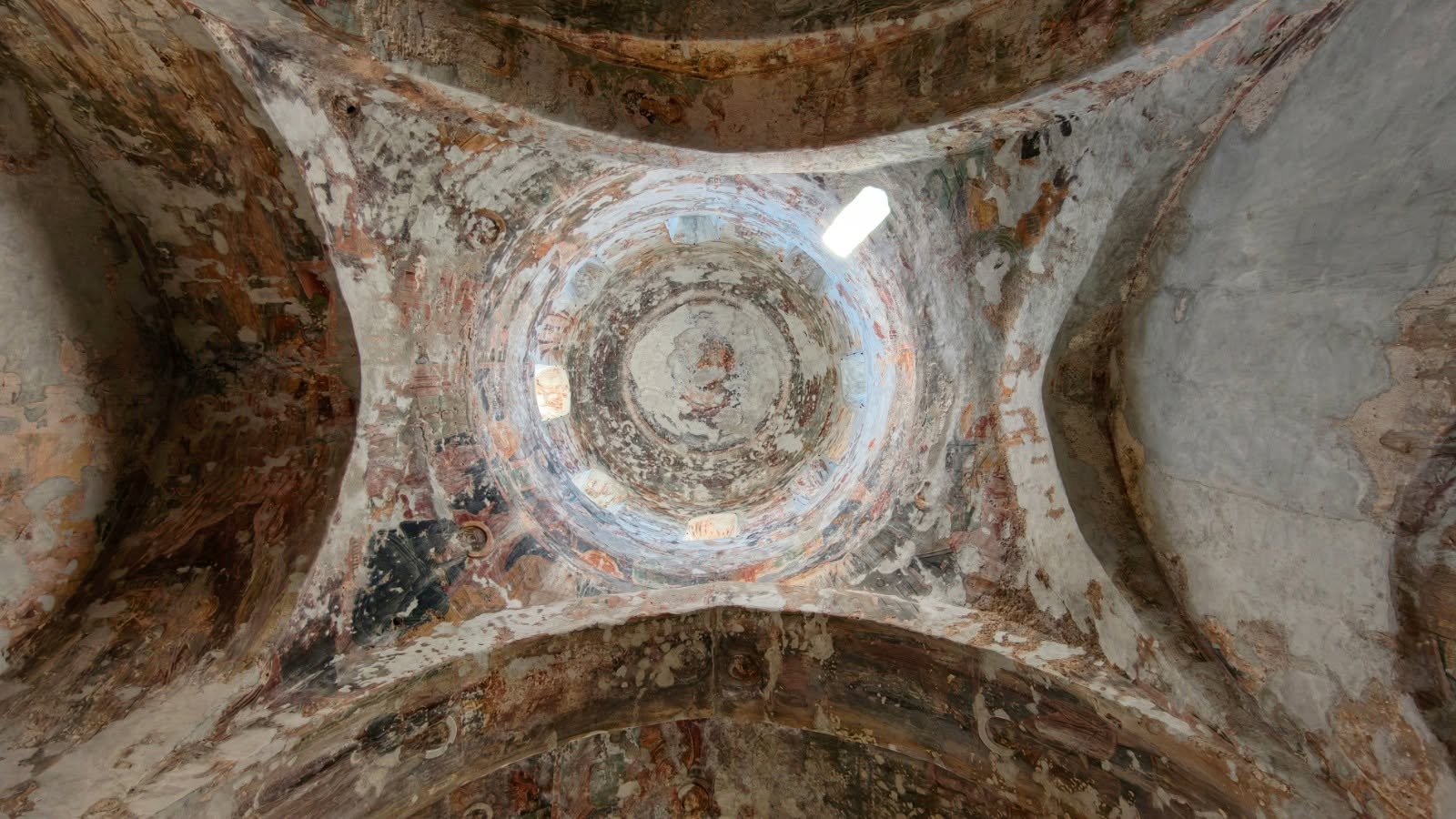
The restoration project will include strengthening the monastery's stone masonry, preserving its wall paintings, completely replacing the roofing, and installing a drainage system.
Before the work begins, specialists have conducted architectural, engineering, and structural surveys to assess the condition of the buildings and determine the appropriate restoration methods.
Details of the project were presented to local authorities by Tea Oniani, First Deputy Director General of the National Agency for Cultural Heritage Preservation of Georgia, and Guram Sutidze, head of the company responsible for developing the restoration project.
The Shemokmedi architectural complex consists of two churches, a bell tower, and a stone enclosure. Its principal buildings are the three-nave Basilica of the Savior, dating from the 12th–14th centuries, and the domed Zarzma Church, built in the late 1570s.
The monastery holds particular significance for the Georgian Orthodox Church as the place where the episcopal ministry of Catholicos-Patriarch Ilia II of All Georgia began. From 1963 to 1967, he served as Bishop of Shemokmedi.
Today, the monastery also serves an important administrative role, bringing together Orthodox parishes across three municipalities in the Guria region.
A Historic Center of Georgian Orthodox Christianity
Situated on a small hill overlooking the village of Shemokmedi, on the left bank of the Bzhuzhi River in southwestern Georgia, the monastery was founded in the 15th century. For several centuries, it served as an episcopal seat and burial place of the princely Gurieli family.
The complex includes the churches of the Savior and the Transfiguration of the Lord, the latter also known as Zarzma, as well as a bell tower and a surrounding stone wall.
The oldest surviving building is the three-nave Basilica of the Savior, dating from the 12th–14th centuries. The domed Zarzma Church was constructed in the late 1570s at the direction of Prince Vakhtang I Gurieli. It became home to a revered 9th-century icon of the Transfiguration, transferred from Zarzma Monastery in Samtskhe after the region came under Ottoman control.
During the 16th–18th centuries, Shemokmedi housed an extensive collection of ecclesiastical treasures, icons, manuscripts, and other religious artifacts gathered from monasteries throughout Georgia.
The monastery experienced a difficult period in the early 19th century. It was damaged in 1820 during an uprising against the Russian Empire and subsequently suffered several episodes of looting, resulting in the loss of much of its historic treasures.
Scholarly interest in the monastery grew during the 19th century. Historian Dmitry Bakradze produced the first academic description of its collection after visiting the site in 1873. In 1889, Russian Byzantinist Nikodim Kondakov catalogued the surviving artifacts.
Since 1924, most of the remaining treasures have been preserved in the collections of the Georgian National Museum.
The planned restoration aims to safeguard this important religious and cultural heritage site, which remains closely connected to the history of the Georgian Orthodox Church.







-

Too Much Freedom?
Alexey Shirikov
All Authors