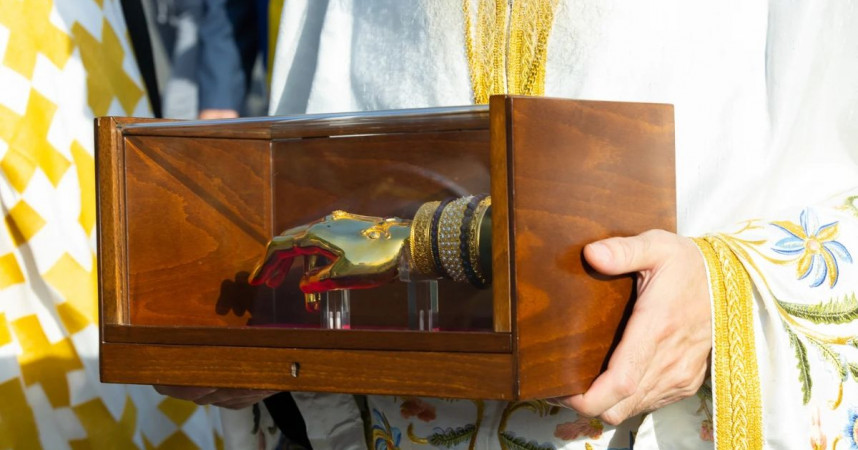
The right hand of St. Basil the Great was brought from Greece to the Romanian city of Alexandria, where it was displayed for the veneration of the faithful. The relic was brought to the city for the feast of St. Alexander of Constantinople, the heavenly patron of Alexandria and its cathedral, according to Basilica.ro.
The Divine Liturgy at the Cathedral of the Alexandria Diocese was celebrated by Bishop Galaction, together with Greek Bishop Nicodemus and Bishop Nectarios of Ireland and Iceland. Hundreds of worshippers gathered before the relic.
Speaking about the relic of St. Basil, Bishop Nicodemus described the saint’s right hand as a symbol of his encounter with the faithful. According to the bishop, it was with this hand that Basil blessed people, helped those in need and served his neighbors.
“St. Basil the Great is not a distant historical figure for us. He remains a living father, teacher and shepherd,” Bishop Nicodemus said.
The celebration in Alexandria also honored St. Alexander, who served as Archbishop of Constantinople in the fourth century and became known as a defender of Christian doctrine. In 325, he participated in the First Ecumenical Council of Nicaea, where he opposed the teachings of Arius, who denied the divinity of Christ.
Bishop Nectarios described St. Alexander’s defining qualities as firm faith, zeal in defending Orthodoxy and a willingness to make sacrifices. He noted that the saint opposed Arianism for many years and defended the teachings of the Christian faith.
On the eve of the feast, a procession was held in Alexandria with the relics of St. Basil the Great, St. Alexander of Constantinople and St. Mary Magdalene. According to Bishop Galaction, the tradition of such processions was revived in Romania after 1990. During the procession, the faithful pray for the protection of the city and its residents.
A particle of St. Alexander’s relics was also presented to the local diocese. The relic of St. Basil the Great will remain in Alexandria until September 1 before being taken to Pantocrator Monastery in Drăgănești-Vlașca, where it will be available for veneration until midnight on September 2.
The feast of St. Alexander has particular significance for Alexandria, where he is regarded as the city’s heavenly patron. The cathedral also already houses particles of his relics.
St. Alexander was born around 239 in Calabria. In his youth, he lived a life devoted to prayer and fasting before traveling to Byzantium. He was consecrated a bishop in 314 and became head of the Church of Constantinople following the death of Patriarch Metrophanes. Alexander died in 337 at the age of 98.
In Romania, the commemoration of St. Alexander has significance beyond the Church. According to local authorities, more than one million people named Alexander, Alexandra and related variants celebrate their name day on his feast.





-

Woe to You, Actors
Alexey Shirikov
All Authors