Saint Sophia, in the world the Grand Duchess Solomonia Saburova, was the first wife of the Grand Duke of Moscow Vasily Ioannovich (1505-1533). He chose her as his wife out of five hundred of the most beautiful girls. But the marriage turned out to be childless, which the Grand duchess greatly grieved. After 20 years of marriage, despite the exhortations of the clergy, the Grand Duke decided to enter into a second marriage with Lithuanian Princess Elena Glinskaya. Metropolitan Varlaam, who denounced the illegality of the dissolution of the marriage, was removed from the metropolitan throne – for the first time in Russian history – and imprisoned in a monastery, and the Monk Maxim the Greek, who interceded for Princess Solomonia, was banned and also imprisoned. All the Ecumenical patriarchs condemned the Grand Duke's act, and Patriarch Mark of Jerusalem predicted the birth of a child from a second marriage who would amaze the world with his cruelty (John the Terrible).
On November 25, 1525, Grand Duchess Solomonia was forcibly tonsured into monasticism with the name Sofia in the Moscow Rozhdestvensky Monastery. After taking the veil, she was sent into custody to the Suzdal Pokrovsky Monastery, which later became the place of imprisonment of involuntary royal tonsured women. The Grand Duchess did not immediately reconcile herself to her new position, and she grieved for a long time. But, having submitted to the will of God, Sophia found solace and peace in fervent prayer.
Nun Sophia, having learned the vanity of fleeting earthly blessings, longed with all her soul for the Kingdom of God and his righteousness (Matthew 6:33). While iniquities multiplied in the world, she was adorned with virtues in her solitude and gradually ascended to spiritual perfection. Prince Kurbsky, in his epistle to John the Terrible (1533-1584), called the princess-nun a "venerable martyr."
Saint Sophia died in 1542 and was buried in the Suzdal Pokrovsky Monastery. The book of Degrees says about this: "Having lived gratefully and pleasing to God, go away." Even the closest descendants prayerfully revered St. Sophia. In the handwritten saints, she is referred to as "the holy Righteous Princess Sophia, a nun who lived in the Devich Monastery of the Intercession, a wonderworker." Under Tsar Theodore Ioannovich (1584-1598), the son of the Terrible, she was already revered as a saint. Tsarina Irina Feodorovna sent a "velvet veil with the image of the Savior and saints" as a gift to her tomb.
Patriarch Joseph (1642-1652) wrote to Archbishop Serapion of Suzdal about holding prayer services and memorial services over the tomb of St. Sophia. Later, in the 19th century, Archbishop Serapion of Suzdal and Tarusa composed a service for St. Sophia.
In the description of the city of Suzdal, the sacristan Ananias reported miraculous healings at the tomb of St. Sophia. So, in 1598, Princess Anna Nechteva, who had been suffering from blindness for six years, regained her sight at her tomb. In 1609, during the Polish invasion of Russia, St. Sophia saved Suzdal from ruin. She appeared in a menacing form to the leader of the military detachment of Poles, Lisovsky. His arm was paralyzed from fear, and he vowed to leave the city and monastery alone. Many other miracles were performed through the prayers of St. Sophia.
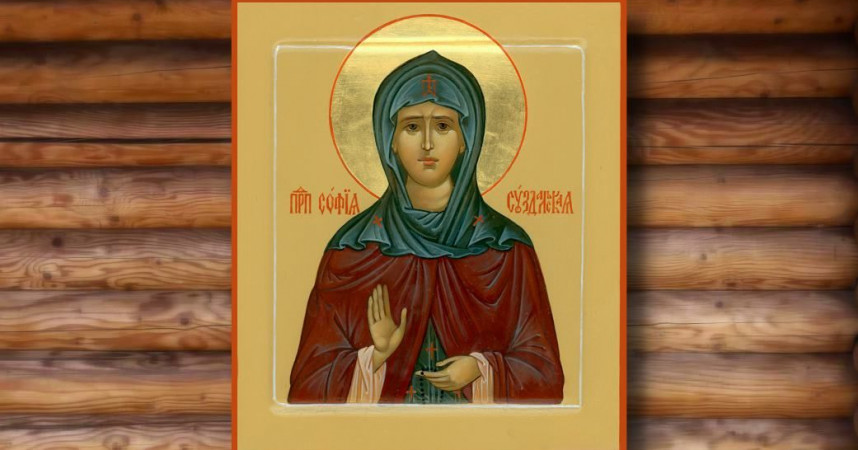
The Church remembers St. Sophia of Suzdal
14.08.2026, 06:00


-

Invisible Wings
Yana Kapaeva
All Authors