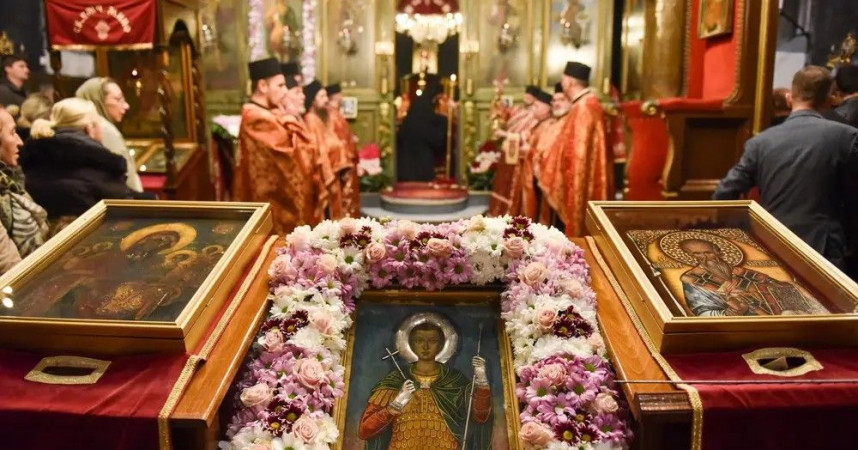
The 130th anniversary of the consecration of the Church of St. Great Martyr Demetrius, one of the oldest and most significant Orthodox churches in Skopje, was celebrated in the capital of North Macedonia on November 7, on the eve of the saint’s feast day, according to the news portal Liturgija.mk.
The celebrations began with an evening service and an akathist hymn at the church, presided over by Metropolitan Joseph of Tetovo and Gostivar. Archbishop Stefan, head of the Macedonian Orthodox Church, Metropolitan Agatangel of Povardarie, clergy members, and numerous faithful also took part in the service.
A formal commemorative ceremony followed at the Museum of the Macedonian Struggle for Independence. Representatives of the Church, municipal authorities, and the cultural and academic communities attended the event.
In his address, Archbishop Stefan highlighted the church’s importance to Orthodox life and the faithful, emphasizing his own personal connection to the historic sanctuary. The church’s rector, Father Zharko Georgievski, presented an overview of its long history.
The history of the church predates its present building by several centuries. Historical accounts indicate that an Orthodox church stood on the site as early as the Middle Ages, possibly dating back to the 13th century. In 1727, St. Demetrius was mentioned as the cathedral church of Skopje. It also served as the residence of the Metropolitan of Skopje and remained one of the city's principal centers of Orthodox life for centuries.
The church acquired its present architectural appearance in 1896, following extensive reconstruction and expansion supervised by renowned master builder Dame Andreev Damyanov. The iconostasis and frescoes were created by prominent Macedonian artist Dimitrija Andonov-Papradishki.
The building was damaged in the devastating earthquake that struck Skopje in 1963. Its interior was subsequently restored and repainted.
The church also holds particular significance for the Macedonian Orthodox Church. The narthex contains the tomb of Archbishop Dositej (Dosifey), who headed the Macedonian Church from 1958 to 1981. His successor, Archbishop Angelarius, is buried near the eastern wall of the church.
The two burial sites make the church an important memorial to the development of the modern Macedonian ecclesiastical organization, in addition to its architectural and historical significance.
The Macedonian Orthodox Church declared its independence in 1967. In 2022, the Serbian Orthodox Church recognized its autocephaly, paving the way for the restoration of Eucharistic communion with the other local Orthodox Churches.





-
Too Much Freedom?
Alexey Shirikov
All Authors