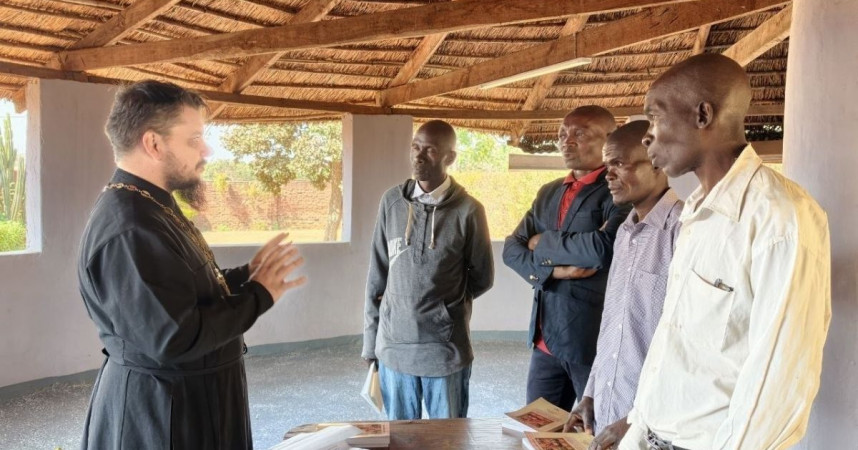
A pastoral gathering and a seminar for catechists were held in the city of Lumbadzi, Malawi, bringing together clergy from across the region, according to the website of the Patriarchal Exarchate for Africa. Participants discussed the practicalities of ministry in remote rural parishes, preparing sermons, and instructing new converts. They also conducted hands-on training on the performance of the Proskomedia within the Russian Orthodox liturgical tradition.
The meeting took place on August 15 and was led by Archpriest Tigrig Khachatryan, head of the Apostleship of Mark the Evangelist and Apostolic Evangelist’s Spiritual and Educational Center. The event included the dean of parishes in Malawi, Father Ioakim Bakali, along with local clergy.
One of the main topics was day-to-day pastoral work in far-flung rural communities. Clergy shared their experiences in spiritually caring for parishioners and serving the sacrament of Repentance, while also addressing the challenges parishes face due to their distance from one another and a shortage of church literature.
A key practical session was led by Father Anatoly Slobodchikov, who explained in detail how to perform the Proskomedia—a part of the Divine Liturgy in which the priest prepares bread and wine for the later celebration of the Eucharist—according to Russian liturgical practice. Participants reviewed the sequence of actions and the symbolic meaning of key liturgical elements.
“Behind us in these days are Liturgies, meetings, seminars, and fellowship. We brought here service books, textbooks, and various teaching materials,” Archpriest Tigrig Khachatryan said. He added that the participants hope the ongoing work in East Africa will “bear good fruit.”
Service books prepared by the Apostleship of Mark the Evangelist’s Spiritual and Educational Center were provided to all local clergy.
A separate seminar was held for catechists. Its participants discussed how to conduct conversations with people beginning to learn about Orthodox Christianity, how to explain the basics of the faith amid the diversity of local traditions, and how to prepare both adults and children for Baptism. Catechists were also given a workbook for studying Gospel parables.
The meetings were organized in an open question-and-answer format, with participants sharing their experiences and raising issues from parish life.
Malawi is one of the countries in East Africa where Orthodox Church activity is growing. Local parishes belong to the South African Diocese of the Patriarchal Exarchate for Africa of the Russian Orthodox Church.
In recent years, particular emphasis has been placed on preparing local clergy and supplying parishes with liturgical and educational materials. In June, five newly ordained priests from Kenya, Malawi, Uganda, and Zimbabwe served the Divine Liturgy in Moscow alongside Metropolitan Constantine of Cairo and North Africa, the Exarch for Africa. The service was celebrated in Church Slavonic, English, Swahili, Chewa, and Shona.
Earlier, in February, Metropolitan Constantine visited Malawi, where he served worship services, met with clergy, catechists, and parishioners, and delivered Orthodox literature to local communities. Work in Chewa, the country’s national language, was highlighted, with translations of a prayer book and service book provided to clergy and faithful.
Educational initiatives are also expanding. In August, prepared English-language materials for leaders of parish Bible groups are planned for distribution across Kenya, Malawi, and Uganda. The methodology was developed at courses run by the Synodal Department for Religious Education and Catechesis at the Nikolai Ugresh Theological Seminary.


-

Invisible Wings
Yana Kapaeva
All Authors