On October 23, 2026, the St. Petersburg Theological Academy hosted the conference "The Lamp of the Northern Thebaid. The spiritual heritage of Alexander Svirsky: from archival discoveries to national pilgrimage routes." The meeting was timed to coincide with the 520th anniversary of the founding of the Alexander Svir Monastery and the 385th anniversary of the first finding of the relics of the monk. The participants reviewed the history of the monastery, written and artistic monuments related to the veneration of the saint, as well as the prospects for the development of pilgrimage.
Before the meetings began at the academic church of the Apostle and Evangelist John the Theologian, Bishop Mstislav of Tikhvin and Lodeynopol celebrated a prayer service co-served by the rector of the Academy, Bishop Siluan of Peterhof and the clergy of the St. Petersburg and Tikhvin dioceses.
At the plenary session, Bishop Silouan read out the greeting of Metropolitan Varsonofy of St. Petersburg and Ladoga. The address noted the importance of the prayer feat of St. Alexander Svirsky for the spiritual life of Russia. The Metropolitan expressed the hope that the meeting of researchers and clergy would serve to further comprehend the legacy of the saint and the role of the monastery founded by him. Representatives of the authorities and public organizations of St. Petersburg and the Leningrad region also sent greetings to the participants.
One of the central topics was the inclusion of the Alexander Svir Monastery in the national pilgrimage route "The Great Russian Northern Way". As Bishop Mstislav noted, the study of the monk's legacy today combines archival research and the development of new pilgrimage destinations. According to the information presented at the conference, the route connects Moscow and Solovki, passes through 12 regions of Russia and has a length of more than five thousand kilometers. Archpriest Mikhail Shastin, head of the diocesan pilgrimage center, spoke about the pilgrimage traditions and the place of the monastery in this project.
Abbot Anthony (Gutnik), the abbot of the monastery, dedicated his speech to the revival of the monastery. The return to monastic life began in July 1997, when Hieromonk Lukian (Kutsenko) and his brethren arrived at the monastery. The villagers had to rebuild buildings, dismantle rubble and arrange their lives in unheated rooms. In 1998, the monastery was transferred to the St. Petersburg Diocese; at the same time, the relics of the monk, discovered at the Military Medical Academy, were returned to the monastery. Today, the brotherhood has 40 members, 21 of whom have higher theological education.
A significant part of the program consisted of scientific reports. Alexandra Soboleva, Associate Professor at the Moscow Theological Academy, presented a study of the manuscripts of the life of the monk and the history of his veneration. Mikhail Shkarovsky, a professor at the St. Petersburg Theological Academy, spoke about the fate of the saint's relics during the Soviet period, and Alexander Gordienko, a professor at the Military Medical Academy, spoke about the circumstances of their second acquisition and transfer to the Church.
The participants also examined the veneration of Alexander Svirsky in the Old Believer tradition, the literary sources of his life, the development of liturgical texts of the XVI–XIX centuries and the iconography of the saint. Separate speeches were devoted to the silver shrine of the monk, the legacy of the Olonets diocesan brotherhood and the use of monastic buildings in Soviet times.
During the conference, spiritual chants were performed by the St. Petersburg Theological Academy Men's Choir conducted by Deacon Peter Belokrylov.
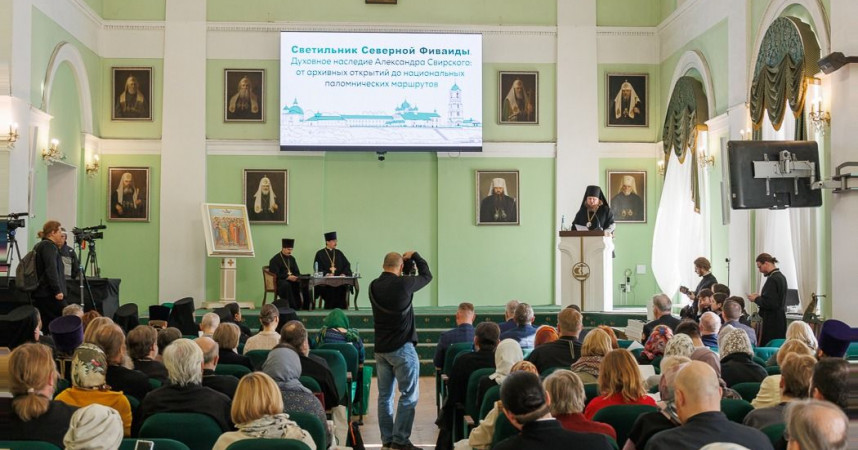
The legacy of St. Alexander Svirsky was discussed at the St. Petersburg Theological Academy
28.10.2026, 09:00





-
“I Praise You, Brothers”: The Spiritual Art of Recognizing the Good
Alexey Shirikov
All Authors