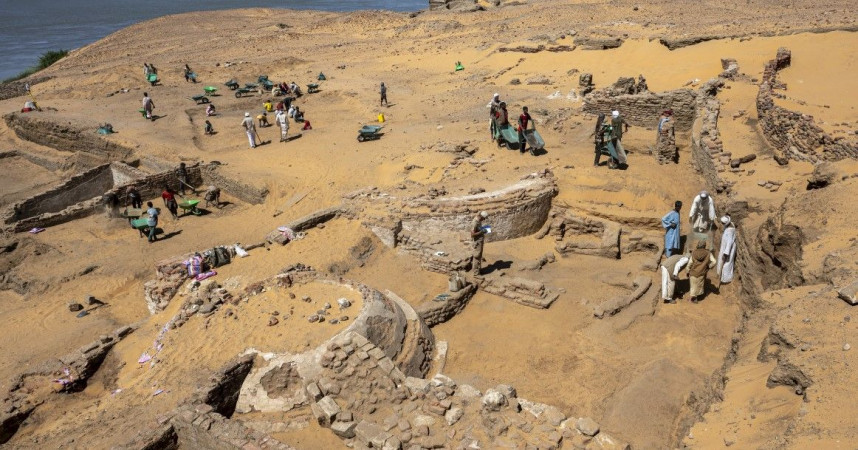
A Polish-Sudanese archaeological expedition has uncovered new sections of a monumental church in the ancient city of Old Dongola in northern Sudan. Researchers have revealed a large staircase and, for the first time, reached the original floor of a building believed to have been the largest and most richly decorated church in medieval Nubia.
The discovery was announced by the University of Warsaw's Polish Centre of Mediterranean Archaeology.
Christian kingdoms flourished in Nubia, in what is now Sudan, from the 6th to the 15th centuries. Their religious traditions developed under Byzantine and Egyptian influence and eventually became closely associated with the Coptic Orthodox Church of Alexandria. Medieval Nubia was home to monumental churches and monasteries decorated with frescoes, while Greek was used in liturgical services.
Excavations are taking place at Old Dongola, the former capital of the medieval Christian kingdom of Makuria, which once controlled a large section of the Nile Valley. The project is being conducted by the University of Warsaw's Polish Centre of Mediterranean Archaeology in cooperation with Sudan's National Corporation for Antiquities and Museums. The expedition is led by Professor Artur Obłuski.
The newly investigated building, known as the Great Church of Jesus, is remarkable for its scale. It measures approximately 47 metres wide and 57 metres long, while its estimated original height may have reached 21 metres. Some of its walls have survived to a height of around 11 metres.
Archaeologists believe the church may have played a major role in shaping the development of religious architecture in Nubia, much as Hagia Sophia in Constantinople influenced church construction across other regions.
Another unexpected discovery was the remains of a church on the second floor of a neighbouring building. Excavations uncovered numerous fragments of wall paintings and plaster bearing Greek inscriptions.
Researchers identified the inscriptions as parts of biblical prayers and hymns. Among them was a fragment of the Prayer of Hannah, the mother of the prophet Samuel in the Old Testament. Texts of this kind have rarely been discovered in previous excavations at Dongola.
The findings could significantly change scholarly understanding of the city's religious history. Until now, another church located outside the city walls had generally been identified as Dongola's cathedral. The latest discoveries have led researchers to consider whether the Great Church of Jesus may instead have served as the principal ecclesiastical centre of the medieval kingdom.

The preservation of the archaeological site remains a major concern. In autumn 2024, Dongola was struck by its most severe flooding since 1988, damaging protective structures installed over archaeological remains.
Alongside its archaeological work, the expedition is also supporting the local population. With assistance from Poland's international development aid programme, solar panels have been installed at the site to provide electricity for pumps supplying water from the Nile.
The system is expected to improve water access for approximately 10,000 residents and support the irrigation of surrounding agricultural land.
The discovery of the Great Church of Jesus represents an important contribution to the study of medieval African Christianity, offering new insights into the religious, architectural and cultural heritage of the ancient Nubian kingdoms.







-

Too Much Freedom?
Alexey Shirikov
All Authors