Blessed John was born at the end of the XV – in the first half of the XVI century. He is known for his deeds of piety in the era preceding the time of troubles and danger for the Russian land. The blessed One was a native of Vologda land. In his youth, he worked in salt factories, for which he was later called a "Water Carrier." From here he went to Rostov, where he began a rare feat of foolishness. He began to wear an iron cap on his head, which is why he was nicknamed the "Big Cap." He also wore tight iron rings on his fingers, and heavy chains of crosses on his body. The holy ascetic ate bread and water once a day. It often happened that Blessed John went out into the street, among the people, put a hood on the ground and, standing on it, looked at the sun for a long time and prayed. Passersby laughed at him and insulted him, but the saint endured the ridicule with meekness and patience.
In Rostov, he was acquainted with the Monk Irinarch, the recluse of Rostov (+ 1616; Comm. January 13/26). Visiting him once in Rostov (c. 1580), Saint John prophetically predicted to him the invasion of the Poles: "May God grant you to teach people from east to west, to fill the earth with disciples, to lead people away from drunkenness. For lawless drunkenness and debauchery, the Lord God will send foreigners to the Russian land... But the Holy Trinity will drive them away by Its own power."
Blessed John spent the last years of his life in Moscow. He walked with his hair down, almost naked, even in severe frosts. His behavior was a challenge to worldly self-satisfaction, his actions and sometimes mysterious words hinted at a hidden daily life. Blessed John often addressed a frank or accusatory word to the powerful of this world, even kings knew him, enduring from him what they would not have endured from another. So, to Tsar Boris Godunov, he often said the words: "Smart head, understand God's works. God waits a long time, but He hurts."
St. John himself predicted his demise by asking Archpriest Dimitri, rector of the Church of the Intercession of the Most Holy Theotokos on the Moat, later named St. Basil's Cathedral, for his resting place.
The events preceding the death of the saint remained in the national memory. On the way out of the temple, the blessed one healed a man who could not use his leg: as if by accident, the saint stepped on it, and the foot became healthy. Then he went to the bathhouse and there, having removed the chains for the first time, he poured water over himself three times, preparing for burial. The saint commanded to perform the burial not earlier than the third day. Then he lay down on a bench, asked everyone for forgiveness and bequeathed to carry his body to the tomb of Blessed Basil in the Intercession Church. With these words, Blessed John peacefully passed away to God on July 3, 1589 (1590).
Many of his contemporaries knew about his exploits. By the decree of Tsar Theodore Ioannovich, the solemn burial of blessed John was performed. However, the burial itself was not performed on the day indicated by the blessed one, but earlier. The Lord allowed a severe thunderstorm with lightning to occur during the divine service as punishment for not fulfilling the covenant of His saint, so that some icons in the Intercession Church were singed and even several clergy and laity were injured. During the burial and later, many of the sick received healing through the prayers of Blessed John. Blessed John also appeared to patients who were far from Moscow, and they recovered.
Shortly after the blessed repose of St. John, the Wonderworker of Moscow, a life and service were compiled. The saint's relics were found incorruptible on June 12, 1672, and buried under a bushel in the chapel of the Nativity of the Blessed Virgin Mary in the Intercession Cathedral. And on January 17, 1916, this chapel was renamed in the name of Blessed John, the Fool for Christ's sake, the Wonderworker of Moscow. The saint is commemorated on the day of his blessed repose, July 3/16, and on the day of the finding of his incorruptible relics, June 12/25.
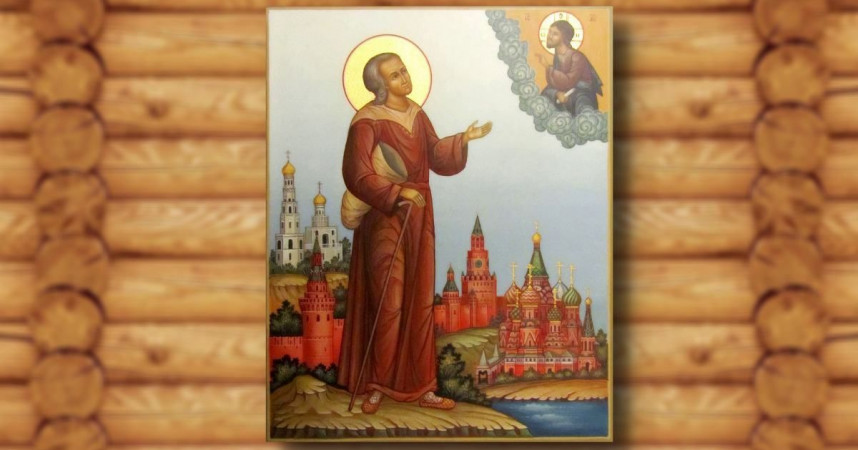
The Church remembers Blessed John of Moscow
16.07.2026, 06:00


-

What Should We Remember?
Olga Kutanina
All Authors