Admiral of the Russian Fleet Feodor Feodorovich Ushakov was born on February 13, 1745 in the village of Burnakovo, Yaroslavl province, into a poor noble family. His parents, Feodor Ignatievich and Paraskeva Nikitichna, were deeply religious people and raised their children in piety. His uncle, Reverend Theodore of Sanaksar, had a great influence on the future naval commander.
Since childhood, Feodor was distinguished by courage, modesty and firmness of character. At the age of sixteen, he entered the Naval Cadet Corps, which he graduated from five years later as one of the best. After graduation, the young officer served in the Baltic Fleet, and then was sent to the Azov Flotilla and the Black Sea Fleet under construction.
In 1783, Feodor Ushakov arrived in Kherson, where the plague epidemic began at that time. He established strict quarantine procedures in his team, personally monitored the condition of the sick and took care of his subordinates. Thanks to the measures taken, the epidemic in his team stopped much earlier than in other units. For his diligence and skillful actions, Ushakov was promoted to captain of the first rank and awarded the Order of St. Vladimir.
During the Russian-Turkish War of 1787-1791, Feodor Ushakov won a number of outstanding victories. Under his command, the Russian fleet defeated superior enemy forces off Fidonisi Island, in the Kerch Strait, off Tendra Island and Cape Kaliakria. He abandoned the usual linear formations, acted decisively and unexpectedly, seeking first of all to disable the enemy's flagship ships.
Ushakov never attributed victories solely to his own art. He thanked God and paid tribute to the courage of his sailors. After the battles, prayer services were held on the ships. The admiral took care of his subordinates, showed mercy to the prisoners and demanded humane treatment of the defeated.
In 1798-1800 Ushakov led the Mediterranean campaign of the Russian fleet. The Ionian Islands were liberated under his command. Of particular importance was the capture of the fortress of Corfu, which was considered impregnable. After the victory, a prayer of thanksgiving was held in the church, and on the feast of Holy Easter, a procession with the relics of St. Spyridon of Trimifunt took place. For this victory, Feodor Ushakov was promoted to admiral.
On the liberated islands, he proved himself not only as a naval commander, but also as a statesman. With his participation, the Republic of the Seven United Islands was formed, the first Greek nation—state of Modern times. Locals called the Russian admiral their liberator and father.
During his entire military service, Feodor Ushakov did not suffer a single defeat, did not lose a single ship, and none of his sailors were captured.
After returning to Russia, the admiral continued his service, but in 1806 he retired for health reasons. He spent the last years of his life in the village of Alekseevka near the Sanaksar monastery. On Sundays and public holidays he came to the monastery for divine services, during Great Lent he lived in the monastery cell, confessed and received communion. He donated a significant part of the funds to the monastery, the poor and the needy.
During the Patriotic War of 1812, Feodor Ushakov helped the wounded, participated in the establishment of a hospital and donated significant sums to form a militia and help people who had lost their property.
The Admiral died on October 2, 1817, ending his earthly life as a faithful son of the Church and the Fatherland. He was buried in the Sanaksar monastery next to St. Theodore of Sanaksar. The residents carried the coffin with the body of the naval commander in their arms from the town of Temnikov to the monastery itself.
The name of Feodor Ushakov has become a symbol of military valor, mercy and Christian service. His life has shown that courage can be combined with humility, victory with generosity, and service to the Fatherland with deep faith and love for others.
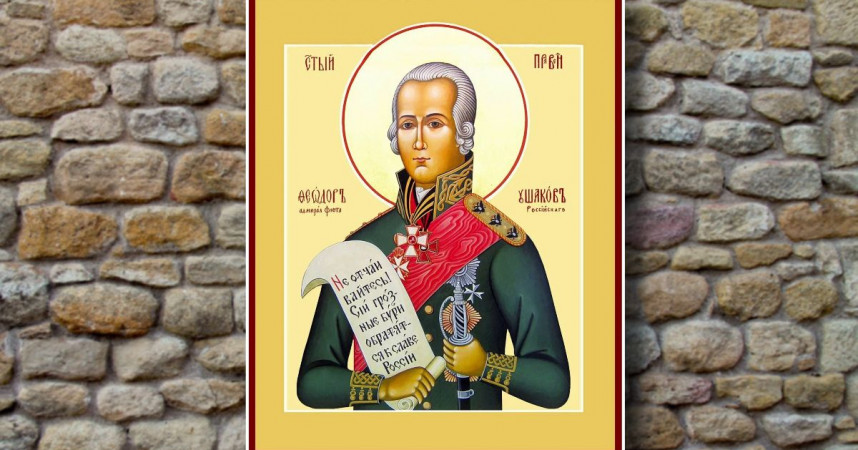
The Church remembers the righteous warrior Feodor Ushakov
05.08.2026, 06:00




-
The Strength of Weakness
Alexey Shirikov
All Authors