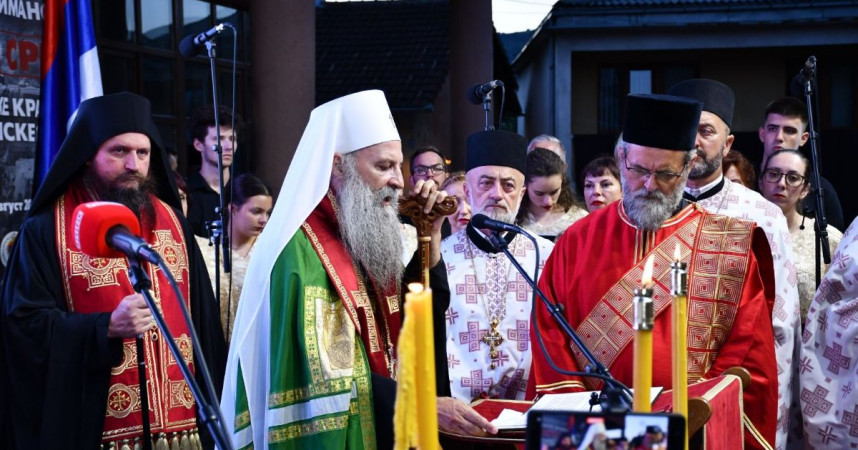
Memorial events were held in Mrkonjić Grad in Republika Srpska, Bosnia and Herzegovina, marking the Day of Remembrance for Serbs who were affected by and expelled during the 1995 military operation “Storm.” The centerpiece of the program was a requiem service (panikhida) officiated by Serbian Patriarch Porfirije.
The service was attended by hierarchs of the Serbian Orthodox Church, representatives from Serbia and Republika Srpska, clergy, and relatives of those who were killed or forced to leave their homes amid the events of that period.
Speaking to those gathered, Patriarch Porfirije said the Church comes together every year to pray for the innocent who suffered and to keep alive the memory of people who lost their native places. “Sorrow does not end with time, and our duty before God—to remember our kin and our fellow sufferers—remains unchanged,” he said.
The Patriarch stressed that Christian remembrance of tragedies from the past should not become a cause of new divisions. He said prayer helps preserve historical truth while freeing the heart from hatred. “Prayer is the deepest and most dignified form of remembrance. It guards the truth, and the heart is freed from hatred—hatred that again ties a person to evil,” Patriarch Porfirije said.
He also urged believers to maintain unity within their own people while striving for peaceful coexistence with others. “We are called to keep peace and harmony among ourselves, but also to live in peace, mutual respect, and good neighborliness with all people and peoples with whom we share this space,” the Patriarch added.
Operation “Storm” began on August 4, 1995. It was a major Croatian military and police operation against the forces of the Republic of Serbian Krajina during the war in Croatia, with fighting taking place in Banija, Kordun, Lika, and northern Dalmatia. On August 5, Croatian forces entered Knin, one of the principal centers of Serbian administration in the region.
After the operation began, hundreds of thousands of people of Serbian origin fled their homes, heading toward Serbia and Bosnia and Herzegovina. Serbian organizations say that during and after the events, around two thousand people were killed or went missing, including a significant number of civilians.
In Serbia, “Storm” is commonly viewed as a tragedy tied to the mass expulsion of Serb residents. In Croatia, the events are described as an important step in ending the war and restoring the country’s territorial integrity. The aftermath remains a particularly sensitive issue in relations between the two countries, and commemorations for the dead and displaced persons continue to be held annually.
In his address, Patriarch Porfirije emphasized the Church’s role in preserving the nation’s spiritual memory. He said remembrance for the victims is not only a look to the past, but also a call to faith, unity, and responsibility toward future generations. “Remembering our sufferers and our native places, we remember who we are and to whom we belong. And we belong to Christ, to His Church, and to one another,” he said, urging believers to follow the Gospel call to love and not allow past suffering to become a source of hostility.
Similar memorial services were also held in Belgrade. At the Church of Saint Mark, a requiem service was conducted for the victims of operation “Storm,” with participation from city officials, civic organizations, and associations of those affected. After the service, participants laid wreaths at a memorial plaque for Serbian war victims at the site honoring victims of wars across the former Yugoslavia.


-

Invisible Wings
Yana Kapaeva
All Authors