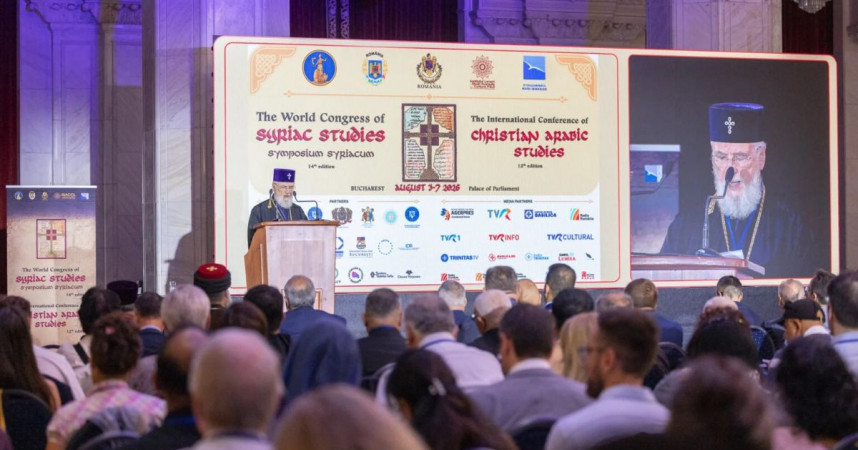
More than 400 scholars, theologians, and representatives of religious communities from 35 countries have gathered in Bucharest for the World Congress of Syriac Studies and the International Conference on the Study of Arabic Christianity.
The event, taking place August 3–7 at the Palace of the Romanian Parliament, will bring together specialists to discuss how to preserve ancient Christian traditions, the role of the Church in protecting cultural heritage, and ways to strengthen interfaith dialogue.
Representatives of Orthodox Churches, Eastern Christian communities, the academic sector, and government institutions took part in the opening, according to basilica.ro. Organizers said the forum includes delegations from 176 universities around the world, including major research centers in Europe and the United States.
A central focus of the program is the Syriac Christian tradition, long seen as a guardian of the East’s most ancient spiritual and cultural inheritance. Organizers noted that the Syriac language preserved the early Christian community’s tradition—reflecting its close connection to the world of Jesus Christ and his disciples.
Romanian Patriarch Daniel addressed participants with a message read at the opening. He highlighted the historical links between the Romanian and Antiochene Churches and emphasized the role of Romanian territories in preserving Orthodoxy in the Arab East.
In the message, Patriarch Daniel pointed to support provided in the 18th century by Romanian princes and Orthodox Church hierarchs to Christians of the East. He said this backing helped foster Arabic Orthodox printing, citing initiatives associated with Wallachian ruler Constantin Brâncoveanu and the work of the future saint Anfim Ivireanul. According to the message, the first Orthodox liturgical books in Arabic were printed in the early 18th century at the Snagov Monastery near Bucharest.
“Arabic books printed with Romanian support opened a new path in the world of the Levant,” the Patriarch’s message said, adding that the publications helped preserve the Byzantine Christian tradition among Arabic-speaking communities and influenced the development of Christian Arabic literature.
Concluding, Patriarch Daniel stressed that unity, cooperation, and life in the spirit of Gospel love remain vital foundations for strengthening peace and stability in the Middle East.
In a video address, Patriarch Bartholomew of Constantinople underlined the special value of the Syriac tradition as a keeper of theological, liturgical, and cultural memory from the ancient Christian world. He said protecting historical Christian communities in the Middle East is an “urgent moral duty”—not only to preserve Christianity’s presence in the region, but also to safeguard a spiritual heritage that belongs to humanity as a whole. He expressed hope that the work of scholars and theologians would foster dialogue, deepen mutual understanding, and help protect ancient Christian sites and monuments in the East.
The opening also featured a speech by former Romanian president Emil Constantinescu, chair of the Scientific Council of the Institute for Advanced Studies on Culture and Civilization of the Levant. He said the modern world is experiencing rising divisions and conflicts, and that religious faith can help shape a culture of peace.
“If we want to achieve real peace and mutual understanding among people, we should not follow the lowest common denominator, but the highest one—God,” Constantinescu said.
Participants also included leaders and representatives from multiple Christian traditions, including Mar Awa III, Catholicos-Patriarch of the Assyrian Church of the East; Ignatius Ephrem II, Patriarch of the Syriac Orthodox Church of Antioch and All the East; and representatives of the Romanian Orthodox Church.
Over the five days of the conference, participants are set to discuss Syriac literature, ancient biblical manuscripts, the history of Eastern Christianity, Arabic Christian theological thought, canon law, and issues related to preserving the cultural heritage of the Middle East.


-

Invisible Wings
Yana Kapaeva
All Authors