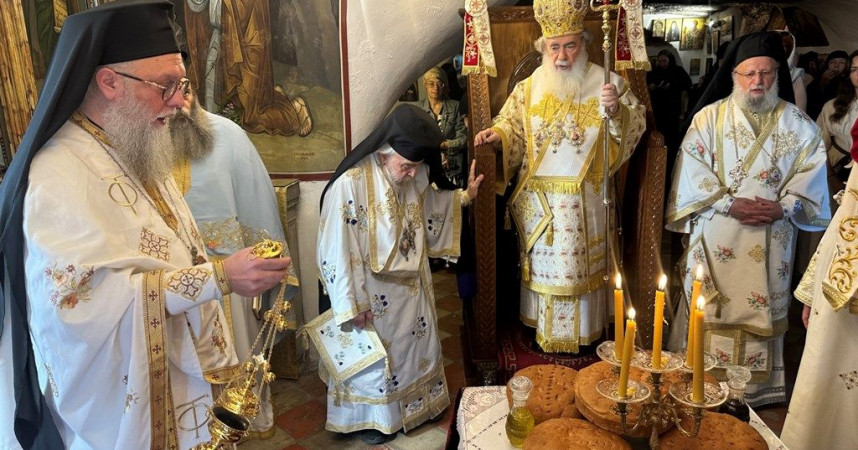
The Jerusalem Patriarchate held solemn celebrations honoring Saint Onuphrius the Great of Egypt and Saint Peter of Mount Athos, with a festive Divine Liturgy celebrated at the monastery dedicated to Saint Onuphrius in the historic area known as “Akeldama,” the biblical “Field of Blood.”
The Divine Liturgy was led by Patriarch Theophilos III of Jerusalem, concelebrated by hierarchs and clergy of the Brotherhood of the Holy Sepulchre. Monastics, pilgrims, and members of local Orthodox communities also attended the service, alongside the Greek Consul General in Jerusalem, Anna Mandika.
The monastery, located near the site traditionally identified as Akeldama—land associated in the Gospel narrative with the price paid for the betrayal of Jesus Christ—stands on a place deeply connected with early Christian history in Jerusalem. Situated opposite the Pool of Siloam, it is regarded as an important pilgrimage site of the Holy Sepulchre Brotherhood and a symbolic link between Gospel events and the early monastic tradition.
Saint Onuphrius the Great, who lived at the turn of the 4th and 5th centuries, is venerated as one of the most prominent figures of early Christian desert monasticism. According to tradition, he began his spiritual life in a communal monastery in the Egyptian Thebaid before withdrawing into the deep desert, where he lived in complete solitude for around 60 years.
Hagiographical accounts describe him as a hermit who survived on minimal plant-based food, had no permanent shelter, and lived entirely in ascetic simplicity. His spiritual inspiration is said to have come from the Old Testament prophet Elijah and John the Baptist, both regarded as archetypal desert ascetics. According to tradition, the monk Paphnutius encountered Saint Onuphrius shortly before his death after a long journey into the wilderness, later recording his life as an example of extreme ascetic devotion.
In his sermon, Patriarch Theophilos III reflected on the spiritual significance of Saint Onuphrius’ ascetic struggle, referencing the Apostle Paul’s teachings on life in the Spirit and divine adoption. He described the saint’s life as an example of total dedication to God and spiritual transformation through prayer and ascetic practice, portraying him as a “vessel of grace.”
Following the Liturgy, a memorial service was held for the late nun Seraphima, and prayers were offered for the blessing of the summer season and the fruits of the earth.


-

What Should We Remember?
Olga Kutanina
All Authors