Saint Arseny of Elasson was born in January 1550 in the village of Kaloriana near the Greek city of Trikala, into the pious family of the priest Theodore and Chrysanthi. After the death of her husband, his mother took monastic vows with the name of Christodoula. Having lost his father at an early age, the future saint was brought up in the home of his elder brother Joasaph, Bishop of Stagon, under whose guidance he received his primary education.
Arseny continued his studies at Trikala with well-known church mentors, studying the Holy Scriptures, theology, ancient languages and church literature. In 1572, he became a monk, and was soon ordained a hierodeacon. A few years later, at the Dusiku monastery, the saint accepted the rank of hieromonk. His scholarship, piety, and zeal for church service were noticed by Patriarch Jeremiah II of Constantinople, who summoned Arseny to Constantinople. In 1584, he was appointed Archbishop of Dimonica and Elassona.
In 1585, Saint Arseny visited the Russian land for the first time as part of the embassy of the Patriarch of Constantinople. On the way back, he stopped in Lviv, where, at the request of the Orthodox brotherhood, he taught Greek and Church Slavonic for two years. For the fraternal school, the saint compiled a curriculum and a bilingual Greek-Slavic grammar, seeking to strengthen Orthodox education in a region where believers suffered oppression.
In 1588, the saint again arrived in Moscow together with Patriarch Jeremiah II. He took an active part in the negotiations on the establishment of the Moscow Patriarchate, was present at the election of St. Job, and on January 26, 1589, he co-served at his installation as Patriarch of Moscow and All Russia. Having received permission from Tsar Theodore Ioannovich to stay in Moscow, Arseny served for many years as a link between the Russian Church and the Orthodox East.
The saint copied and decorated liturgical books, composed church hymns, and sent icons and sacred vessels to monasteries in Mount Athos, Palestine, Sinai, and Greece. He wrote a service to St. Basil the Blessed, a poetic narrative about the establishment of the Moscow Patriarchate, and a History of Russia. Since 1597, Arseny has been Archbishop of Arkhangelsk and keeper of the royal tombs in the Archangel Cathedral of the Moscow Kremlin. At his own expense, he built and restored churches, took care of their decoration and supplied them with liturgical books.
The saint endured severe trials during the years of Troubles. He witnessed the devastation of Moscow, the fire in the Kremlin, famine and siege. Having lost almost all his possessions, Arseny did not leave his flock. In 1612, St. Sergius of Radonezh appeared to him and announced the imminent deliverance of the Russian land from disasters. After the liberation of the capital, the saint, at the head of the clergy, met the Russian militia with the Vladimir Icon of the Mother of God, and then participated in the election and crowning of Mikhail Feodorovich Romanov.
In 1613, Arseny was appointed to the Tver department, where he resumed church life, restored churches and took care of the daily performance of divine services. Later he became Archbishop of Suzdal and Tarusa. The saint participated in church councils, in the ordination of Patriarch Filaret, and in the investigation of the miracles of the Kazan Icon of the Mother of God, which resided in Suzdal.
Saint Arseny passed away peacefully on April 29, 1625 and was buried in the Christmas Cathedral of Suzdal. His local veneration soon began, and in 1668 the incorruptible relics of the saint were found. Mothers who prayed for the healing of sick children turned to him especially often. In 1982, the name of St. Arseny was included in the Cathedral of the Vladimir Saints. In church hymns, he is glorified as the "unshakable pillar of piety" — a learned archpastor, educator and faithful servant of the Church, who united the Orthodox peoples of Greece and Russia with his life.
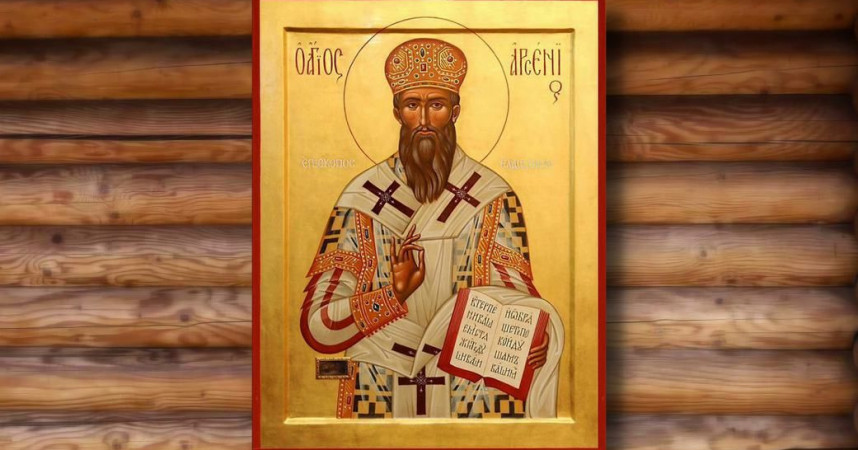
The Life of St. Arseny of Elasson, Archbishop of Suzdal and Tarusa
17.08.2026, 06:00


-

Invisible Wings
Yana Kapaeva
All Authors