St. Stephen was born in the second half of the XV century in the Vologda country from pious parents. His father served at the princely court and tried to give his son, as much as possible then, the best upbringing and education. He was preparing in him a successor for himself and a good servant to his princes, but the enviable and desirable court life for others was not to the liking of the young chosen one of God.
At that time, the desert Lavra of Dionysiev was famous for its fasting exploits (Venerable Dionysius Glushitsky, + 1437; commemorated on June 1/14). The monastery's strict cenobitic charter, which did not allow monks not only to own any property, but also to do anything without the abbot's command and blessing, and its remote location in a remote forest corresponded to Stephen's desire, who sought silence. And he, leaving the princely court, relatives and friends, went to the Wilderness and humbly asked the abbot and the brethren to accept him into their monastery. Touched by Stephen's persistent entreaties and tears, the abbot accepted him first as a novice, then, seeing his zeal and labors, he tonsured a monk with the name Stephen and entrusted him to an experienced elder for guidance in spiritual life. The new monk devoted himself entirely to the will of his leader and tried to imitate him in everything, spending his days in monastic labors and his nights in vigil and prayer. However, the more he strengthened himself in his labors and grew in his spiritual life, the more it seemed weak and imperfect to him, the more he humbled himself and lost himself. After several years of living in the Wilderness, Stefan, with the blessing of the abbot and the elder-leader, set out to wander through the northern deserts and monasteries in order to further improve his spiritual life. He wanted to take advantage of the wise advice of the spiritual elders, take a closer look at their exploits and labors, and thus acquire the skill and experience in spiritual work. Wandering in this way, he reached Tikhvin and settled here, rejoicing that he could worship the miraculous icon of the Mother of God every day. However, he did not stay here for long: numerous crowds of men and women who came to the monastery daily to worship the holy icon, noisy conversations that gave the monastery the appearance of a secular village and a celebration, disturbed the silence in the monastery. Therefore, after living in Tikhvin for some time, Stefan, carried away by his love of silence and solitude, returned to his native Vologda.
Moving from place to place, from forest to forest, the monk reached the deserted lake Komelsky, surrounded on all sides by mosses and swamps. He liked this place, which was uninhabited and remote from worldly villages, and he decided to stay here forever. Having built himself a cell on the eastern shore of the lake at the source of the Komela River and built a small chapel for two icons he brought from the Tikhvin monastery – the Mother of God and Nicholas the Wonderworker, he began to strive in fasting and prayer, unknown to people and guided only by One God. It is impossible to express all that the monk had to endure. Stephen in the first years of his life in the desert, what temptations to be exposed to and what hardships and sorrows to endure. Stephen had brought a small supply of bread, and he was in danger of a complete lack of food. More than two years later, two hunters accidentally found him and shared their travel supplies with him. From them, he learned the path leading to the Belozerskaya road and the villages: otherwise, he could not, and forced by extreme circumstances, to get to residential areas. After that, the hunters began to visit Stefan, and others learned about him from them.
In the midst of such labors and temptations, the grace of God did not leave the monk with his consolation and help. One summer night, when St. Stephen was praying with great fervor and tears in his chapel before the icons of the Mother of God and St. Nicholas, the Blessed Virgin and St. Nicholas the Wonderworker suddenly appeared to him in a wonderful light. Stephen, overcome with holy terror, fell to the ground before them and heard Saint Nicholas beg the Most Pure Virgin to bless Stephen's place of residence for a monastic monastery. At the prayer of the saint, the Mother of God commanded the hermit to build a temple in the desert in the name of Saint Nicholas and to be the head of the new monastery himself. With these words, the wonderful visitors became invisible, filling Stefan's heart with unspeakable joy.
Even before that, on a summer night, he had prayed fervently in the chapel so that the Mother of God would bless his place for the monastery of prayers; then in a vision he was informed that the monastery was to be built in honor of St. Peter. Nicholas.
After three years of living alone in the desert, two brothers came to St. Stephen to share the labors of the hermit, and then several more came with similar desires. The zealots of the desert life asked the elder to build a temple for prayer. With one of them, he went to Moscow to ask for the blessing of the metropolitan for the construction of a temple and monastery. Metropolitan Daniel lovingly received the elder, whom he had previously heard of, placed him in his cell and then introduced him to Grand Duke Vasily Ioannovich. The Grand Duke, who was generally inclined to monasticism, especially respected the monks of the Vologda monasteries, which he visited almost all personally in 1528, asking God for an heir. After many spiritual conversations with the prince and Metropolitan, the humble hermit Stephen was ordained to the priesthood and appointed abbot of the new monastery. Together with the letter for the construction of the temple and monastery, he received from the metropolitan all the necessary church utensils, and the Grand Duke gave him his letter for lands and lands for the maintenance of the brethren. Thus, with complete spiritual and material consolation, the monk returned to the dense forests of his desert to the brethren who were waiting impatiently for him.
Arriving at the lake, he first of all directed his way to the chapel and himself served the first prayer of thanksgiving to the Mother of God and St. Nicholas, who for several years had foreshadowed the foundation of the temple and monastery at that place. The brethren greeted their abbot with joy, prostrating themselves at Stephen's feet, asking for his blessing and reverently kissing the holy Gospel he had brought from Moscow, while he prayerfully overshadowed them all with the Life-giving Cross and asked them to pray for him. A few days after that, they began to build the temple, which they soon created. In 1534, to the great joy of the hermits, the church was consecrated in the name of St. Nicholas and, although in a small form, according to the number of sparsely populated brethren, everything necessary for a dormitory was arranged.
After the consecration of the church, St. Stephen labored for another eight years in the building of his young monastery, setting an example to the brethren in everything, who multiplied every year. As a child-loving father, the blessed elder, meek and merciful to all, was strict only to himself, exhausting his flesh with incessant labors, fasting and vigil. Despite his advanced years, he seemed more like a novice than an abbot in his deserted monastery. He was always the first to attend to monastic labors, trying to serve everyone, to calm and comfort everyone. For this reason, the brethren also loved him as a father, looked upon him as an Angel of God, and tried to imitate him in everything.
Having reached a great old age, the monk, a week before his repose, felt the exhaustion of his strength and foresaw the approach of death. On the eve of it, with the help of his disciples, he dressed himself in funeral vestments that he had prepared for himself long ago, then, led by them to the church, he received the Holy Mysteries from the hand of the liturgical hieromonk. Then he returned to his bed and died quietly on June 12, 1542.
In the same year 1542, when St. Stephen died, the monastery was ravaged by the Tatars. When, during its restoration, they began to build a new church instead of the one burned down by robbers, they no longer put it in its former place, but over the grave of the monk, since many of the pious people began to see a light above it, as if candles were burning. At the same time, according to fresh memory, his image was painted on the tomb of the monk, and another image of him was placed in the newly built church. After that, a special service was written to him.
He who sows into his flesh will reap corruption from the flesh; but he who sows into the spirit of the spirit will reap eternal life, the apostle teaches (Galatians 6:8). Spiritual life, strongly developed in the soul, is not afraid of death – it makes itself felt by wonderful deeds and beyond the grave. The Vologda merchant Gabriel, who knew St. Stephen during his lifetime and worshipped his monastery, sailed with water on his trade business. A terrible storm arose, and the waves threatened to engulf the boat. Gabriel began to call on the saints of God to help him, and among them, Blessed Stephen. And suddenly he saw a magnificent elder in his boat, who said to him: "Do not be afraid, son of humility, the Lord has sent me to save you from drowning." "Who are you?" asked Gabriel, horrified by both the vision and the apparent death. "You gave a lot of alms to the monastery of St. Nicholas. St. Nicholas, on Lake Komelsky, and to me, the humble builder Stefan," replied the one who appeared and disappeared, and after that the storm subsided.
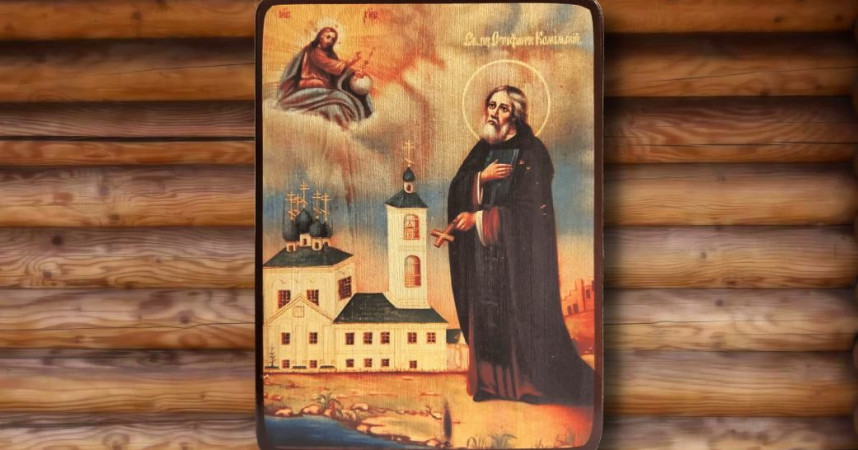
The Church remembers St. Stephen of Ozersk, Komelsky
25.06.2026, 06:00


-

What Should We Remember?
Olga Kutanina
All Authors