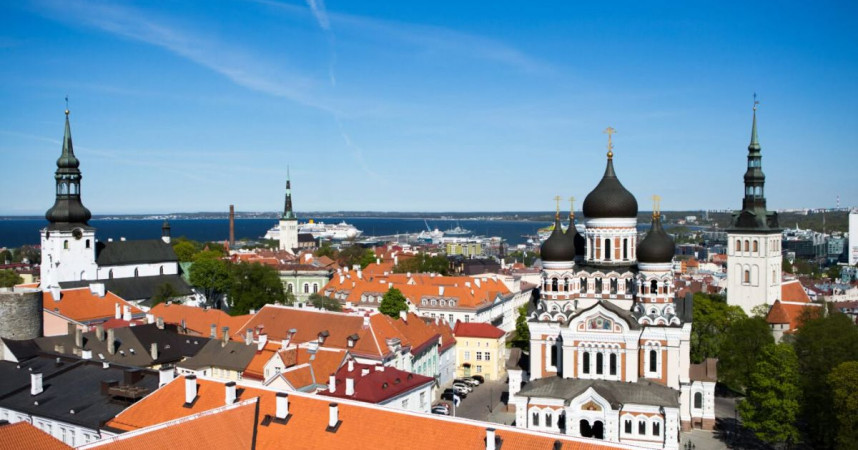
The Estonian Christian Orthodox Church (ECOC) has appealed to Estonia's Supreme Court against the termination of the lease for the building housing the office of the Metropolitan of Tallinn and All Estonia, opening a new legal battle amid an ongoing dispute with the government over the Church's relationship with the Moscow Patriarchate.
The appeal challenges lower court rulings that upheld the City of Tallinn's decision to terminate the lease for the municipal property at 64 Pikk Street, which has served for many years as the Church's administrative headquarters. The Harju County Court initially ruled in favor of the city's Kesklinn District Government, and the Tallinn Court of Appeal confirmed that decision in June.
The Church has now filed a cassation appeal with the Supreme Court, allowing its chancery to remain at its current location until the case is reviewed. No hearing date has yet been announced.
The status of the property has returned to public attention after Tallinn City Council members Sander Andla and Henri Arras of the Reform Party asked the city's mayor whether the Church continues to occupy the premises and what steps municipal authorities intend to take. Tallinn's legal department confirmed that the building has not yet been vacated because the Church's appeal is pending before the Supreme Court.
The property dispute comes as Estonia implements new legislation requiring religious organizations to reassess their relationships with foreign religious authorities if those ties are deemed to pose a threat to national security.
Amendments to the Churches and Congregations Act entered into force on June 27, giving the Estonian Christian Orthodox Church six months to bring its structure into compliance with the new legal requirements. According to the Ministry of the Interior, the Church must end its canonical and administrative ties with the Moscow Patriarchate, elect a new primate to replace Metropolitan Eugene (Reshetnikov), who left Estonia in early 2024, and amend its governing statutes. Failure to comply could lead the ministry to seek the dissolution of the Church's legal entities through the courts.
Church leaders dispute the government's interpretation of the law. Bishop Daniel of Tartu has previously said that although Estonia's Supreme Court upheld the constitutionality of the legislation, significant questions remain regarding its practical implementation.
Attorney Artur Knyazev, who represents both the Estonian Christian Orthodox Church and the Pühtitsa Convent, argues that the law does not explicitly require a complete severance of ties with the Moscow Patriarchate. He maintains that the Supreme Court narrowed the scope of the legislation by stating that government intervention requires proof of a genuine security threat arising not only from the foreign religious organization itself but also from the specific relationship with it. According to Knyazev, the state has not yet presented such evidence.
Legal and religious affairs experts expect the dispute to enter a new phase in the coming months. Priit Rohtmets, an associate professor of church history at the University of Tartu, said that even if the Church amends its statutes, future litigation is likely to focus on the legal status of the 1993 tomos that defines the Church's place within the structure of the Moscow Patriarchate. The document requires certain decisions of the Estonian Church to receive approval from the Patriarch of Moscow and All Rus'.
Rohtmets believes that once the Interior Ministry's six-month compliance period expires, the courts will likely be asked to determine whether the Church has legally and effectively ended its ties with the Moscow Patriarchate.
The Estonian Christian Orthodox Church is therefore facing parallel legal proceedings: one concerning its right to continue using its administrative headquarters in central Tallinn, and another expected to determine whether it will be allowed to continue operating under its current ecclesiastical status.


-

What Should We Remember?
Olga Kutanina
All Authors