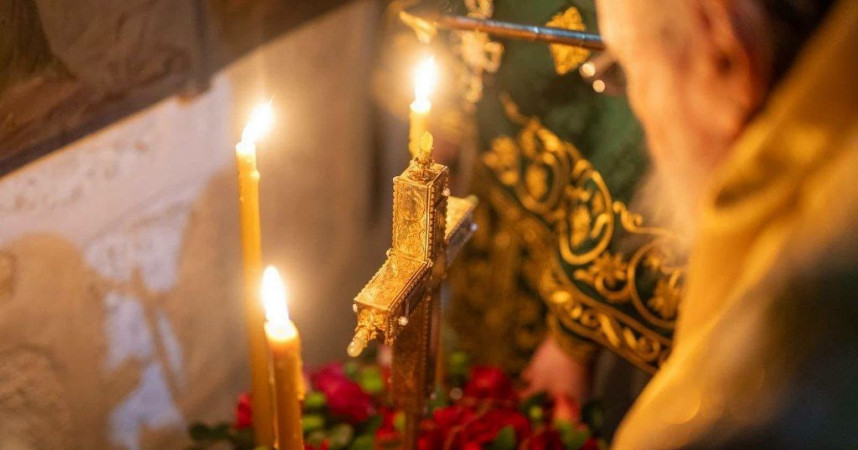
The Feast of the Exaltation of the Holy Cross was celebrated on Sunday, October 4, at the Monastery of the Holy Cross in western Jerusalem, one of the oldest Orthodox monasteries in the Holy Land. According to Christian tradition, the monastery stands on the site where Lot, the nephew of Abraham, planted a tree whose wood was later used to make the Cross on which Jesus Christ was crucified.
The festive Divine Liturgy was celebrated by Archbishop Dorotheos of Avila. Clergy of the Jerusalem Patriarchate, a representative of the Russian Ecclesiastical Mission and guests from Greece took part in the service. Diplomatic representatives of Greece and Georgia were also present.
During the liturgy, Patriarch Theophilos III of Jerusalem visited the monastery, venerated its holy sites and inspected ongoing restoration work. Specialists are currently restoring historic icons, ecclesiastical treasures and books from the monastery library.
In his homily, which was read during the service by the monastery’s abbot, Archimandrite Christodoulos, Patriarch Theophilos focused on the Cross as a symbol of Christian hope and salvation. He recalled the words of the Apostle Paul that the preaching of the Cross appears as foolishness to some, while for believers it becomes “the power of God.”
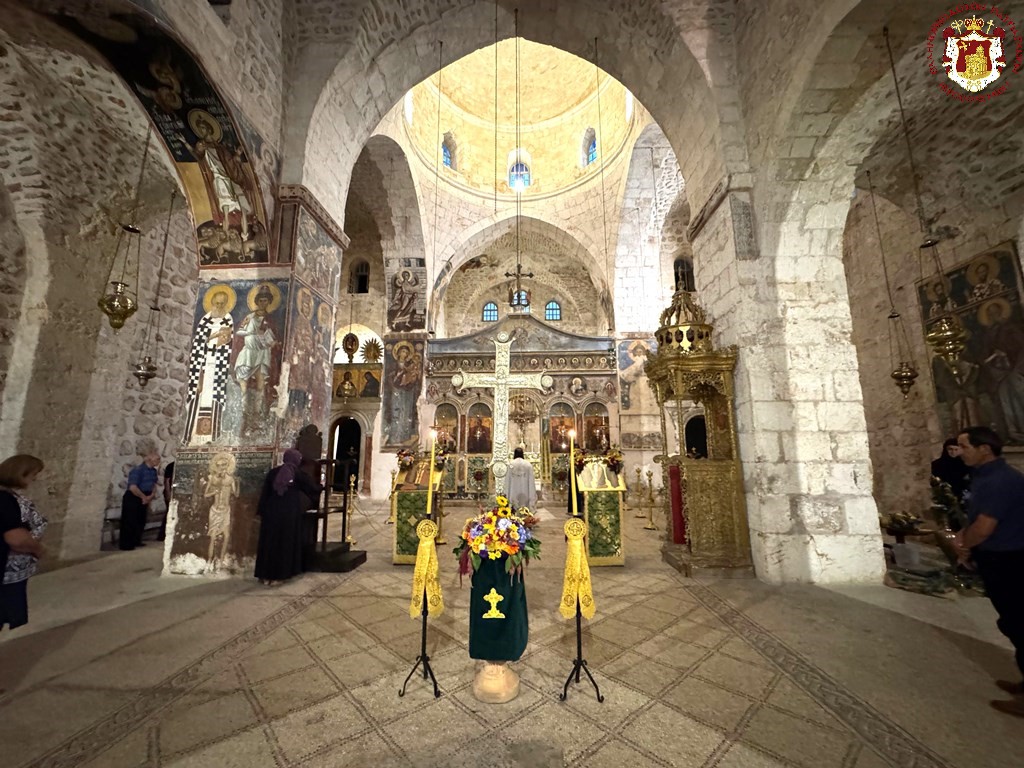
The history of the monastery dates back to the Byzantine period. Archaeologists have discovered fragments of a mosaic floor in the main church dating to around 1040, although the Christian sanctuary on the site is considerably older. The church was destroyed by Persian forces in 614 and was later restored under the Jerusalem Patriarchate.
During the Middle Ages, the monastery became one of the principal centers of Georgian, or Iberian, monasticism in the Holy Land. More than 100 monks lived there, many of whom were engaged in theology, scholarship and the arts. The monastery is also traditionally associated with the renowned 12th-century Georgian poet Shota Rustaveli, who is said to have spent his final years there.
The monastery complex acquired much of its present appearance in the 19th century. Major construction took place in the 1850s in connection with the establishment of a theological school. The present complex includes several floors containing the church, chapels, library, educational facilities and courtyards.
A particularly important chapter in the monastery’s history is the School of the Holy Cross, one of the best-known theological institutions of the Jerusalem Church. The school operated during the 19th and early 20th centuries and educated numerous Orthodox theologians and clergy. Official patriarchal materials date its operation to 1845–1909, while a recent patriarchal account gives the dates as 1844–1909.
Among its graduates were Chrysostomos Papadopoulos, who later became Archbishop of Athens, and Meletios Metaxakis, who later served as Ecumenical Patriarch of Constantinople. The monastery therefore served not only as a place of prayer but also as an important center of Orthodox education in the Holy Land.
The Feast of the Exaltation of the Cross is celebrated at the monastery one week after the principal church feast. The local observance is connected with the ancient tradition concerning the origin of the wood of the Cross. According to the tradition, Lot planted a tree composed of three kinds of wood — cedar, cypress and pine — which was later used in the Cross of Christ.
A chapel in the northwestern part of the main church depicts episodes from this tradition. The annual rite of the Exaltation of the Cross is also celebrated there.






-

The Right Moment
Alyona Bogolyubova
All Authors