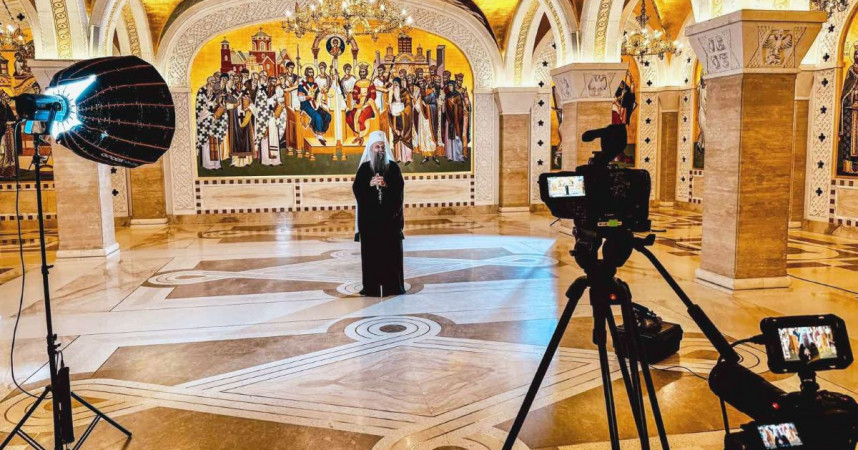
Serbian Patriarch Porfirije has taken part in the filming of a new documentary and television series dedicated to St. Sava, the first Archbishop of the Serbian Orthodox Church and one of the most revered figures in Serbian history.
According to the Serbian Orthodox Church, the opening and closing scenes featuring the Patriarch were filmed in the crypt of the Church of St. Sava in Belgrade, against the backdrop of a monumental fresco depicting Serbian saints. The filmmakers said the Patriarch's appearance gives the project a distinctive spiritual and symbolic dimension, connecting the legacy of St. Sava with contemporary Serbian society and underscoring the enduring significance of his message.
The documentary is directed and produced by Željko Mirković, an award-winning documentary filmmaker and professor at the University of Connecticut. Production is taking place in Serbia, Mount Athos, and the United States.
The filmmakers aim to present St. Sava not only as a leading church figure but also as an educator, diplomat, and unifying force whose commitment to faith, learning, and public service helped shape Serbian national identity. The project is intended for a broad international audience and seeks to introduce new generations to the importance of faith, education, responsibility, and mutual support in Serbian history.
Born around 1175 as Rastko Nemanjić, St. Sava was the youngest son of Grand Prince Stefan Nemanja. He renounced royal life in his youth and traveled to Mount Athos, where he became a monk. Together with his father, who later also embraced monasticism, he restored the Hilandar Monastery, which became the principal spiritual center of Serbian monasticism.
In 1219, St. Sava secured recognition of the autocephaly of the Serbian Orthodox Church from the Patriarch of Constantinople and became its first archbishop. Historians regard this achievement as a milestone that strengthened both the Church's independence and the medieval Serbian state.
St. Sava also played a key role in the development of Serbian law and education. He compiled the Nomocanon of St. Sava (Zakonopravilo), the first Serbian collection of ecclesiastical and civil laws, which served as the foundation of the country's legal system for centuries. He also promoted education by establishing schools at monasteries and is honored today as the patron saint of education in Serbia. His feast day, celebrated on January 27, is observed nationwide in Serbian schools and educational institutions.
St. Sava's relics became a powerful symbol of Serbian spiritual unity after the Ottoman conquest of the Balkans. In 1594, Grand Vizier Sinan Pasha ordered them burned in Belgrade in an attempt to suppress a Serbian uprising. Instead, the act strengthened popular devotion to the saint. The Church of St. Sava, one of the world's largest Orthodox churches, now stands on the site traditionally believed to be where his relics were burned.
The documentary is being produced by Optimistic Film and Telekom Srbija. Its creators say the project is intended not only as a historical account of an influential church leader but also as a cultural testament for future generations, demonstrating that St. Sava's ideals of education, unity, and service to others remain relevant in the 21st century.


-

The Most Valuable Lesson Didn't Come from the Textbook
Tatiana Lyubomirskaya
All Authors