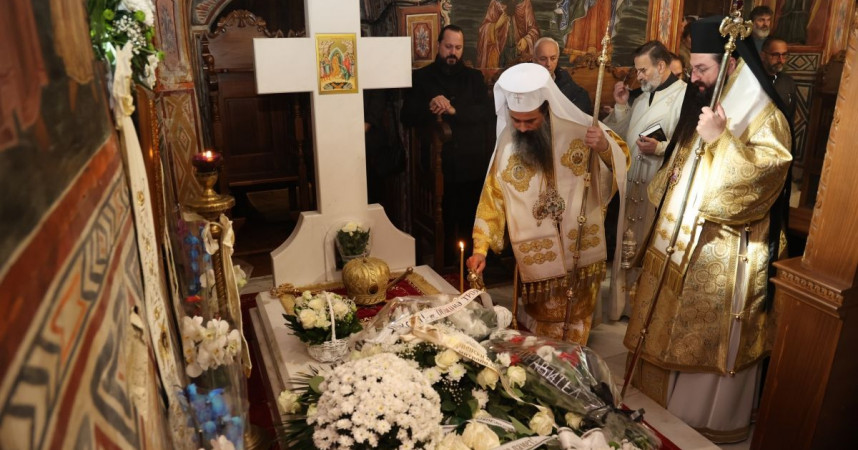
Bulgaria has commemorated the 14th anniversary of the death of Patriarch Maxim, who led the Bulgarian Orthodox Church for more than 41 years. Memorial services were held in three cities: Troyan, Varna and Plovdiv. The main memorial service at Troyan Monastery was presided over by the current Patriarch of Bulgaria, Daniel.
At the Monastery of the Dormition of the Theotokos in Troyan, where Patriarch Maxim is buried, a Divine Liturgy and memorial service were celebrated in the presence of metropolitans and bishops of the Bulgarian Orthodox Church. In Plovdiv, Metropolitan Nikolai led the memorial service at the Church of St. Marina. In Varna, commemorative services were held at the Cathedral of the Dormition of the Theotokos.
Speaking to journalists at Troyan Monastery, Patriarch Daniel described his predecessor as a man of profound faith who devoted most of his life to the Church.
"Of his 98 years, he devoted 86 to the Church. He served during three historical periods — the monarchy, militant atheism and democracy. Despite political and social upheavals, he remained an unwavering pillar through his faith and devotion to God," Patriarch Daniel said.
Patriarch Maxim, born Marin Naydenov Minkov on October 29, 1914, in the village of Oreshak, entered Troyan Monastery as a novice during his childhood. He later described the monastery as the cradle of his spiritual journey.
He took monastic vows in 1941 and was consecrated a bishop in 1956. Throughout his ecclesiastical career, he held several senior positions within the Bulgarian Orthodox Church, including serving as its representative in Moscow and as Chief Secretary of the Holy Synod.
On July 4, 1971, he was elected Patriarch of Bulgaria, a position he held until his death on November 6, 2012.
His patriarchate spanned three distinct periods in Bulgarian history: the monarchy, the socialist era and the country's transition to democracy.
One of the most difficult challenges during his leadership was the church schism of the early 1990s, when a group of clergy questioned the legitimacy of his patriarchal leadership. Patriarch Maxim retained his position and played an important role in overcoming the division and restoring unity within the Church.
Speaking on the anniversary, Bishop Vassily, Abbot of Troyan Monastery, particularly highlighted Patriarch Maxim's patience and restraint during the schism. According to the bishop, although the Patriarch faced attacks and personal insults, he refrained from responding with harsh words and remained committed to preserving the unity of the Church.
Patriarch Maxim died on November 6, 2012. In accordance with his wishes, he was buried at Troyan Monastery, the spiritual home that had played such a significant role throughout his life.





-
Too Much Freedom?
Alexey Shirikov
All Authors